


Construction sites operate on trust. Teams rely on consistent standards, clear communication, and swift action when something goes wrong.
Yet traditional approaches to discipline, like verbal warnings and handwritten notes, leave gaps that can compound over time.
One.site's new red and yellow card system changes that. It transforms site behaviour management into something digital, transparent, and instantly accessible to every team member who needs visibility.
The Problem with Informal Warnings
On a given day, a site manager might pull someone aside and say, "Don't do that again." The conversation happens, and the point is made.
But three weeks later, when the same operative breaks the same rule, does the site manager remember? Construction is very busy, and who’s on site changes often. Without a record, it's nearly impossible to know whether you're dealing with a first offence or a pattern of behaviour.
How Yellow and Red Cards Work
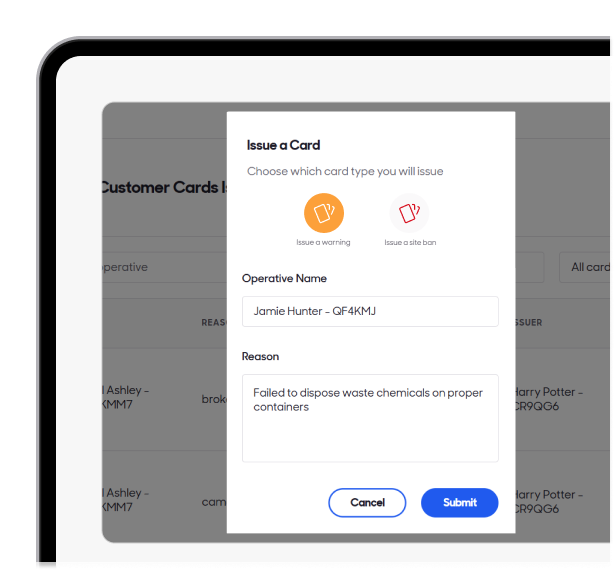
Yellow cards are warnings. When an operative breaks a site rule, a site manager can issue a yellow card directly from the One.site app. That card stays on the operative's profile forever within your organisation, visible to any site manager across any site your company runs. The operative receives a message explaining exactly what happened and why.
Red cards are bans. If an operative receives multiple yellow cards for the same issue, or if something serious warrants immediate action, a site manager can issue a red card. That might be a permanent ban or a temporary one (a week off site, for instance). Like yellow cards, the ban is recorded and visible. If that operative tries to check in, the site manager gets a notification immediately.
The key difference is visibility and continuity. Every card creates a time-stamped audit trail tied to that operative's record that can be referenced at any time.
Why This Matters for Site Managers
The main benefit is accessibility. You might spot an unsafe practice during a site walk, and want to log it straight away. With One.site, you don't need to return to the cabin, find paperwork, and log it later. You can simply pull out your phone, open the app, and issue a card on the spot.
Secondly, it helps with confidence in site decisions. When you see that an operative has already received two yellow cards for the same violation, the decision to escalate to a red card becomes clearer. You're not guessing whether this is a one-off or a pattern because you have the data to back up your decision.
Finally, it creates fairness. A digital system means every operative is measured against the same standard. There's no favouritism because there's no grey area. The card is issued, the reason is recorded, and the operative is informed. This level of transparency protects both the site manager and the operative.
What About Privacy?
Card records are visible only within your organisation. If an operative works for House Builder A and receives a yellow card, that card won’t follow them to House Builder B.
One.site keeps the system fair by ensuring that discipline stays local to the company issuing it. This avoids the risk of penalising someone across multiple employers for something another company's management decided to record.

Built Into One.site
The red and yellow card system is live now, with no additional cost. All existing One.site customers have access. It integrates seamlessly with worker profiles so you can see a complete card history at a glance. There's guidance in the help center for how to use it, and a banner in the app alerts teams to this new capability.
In the first few weeks, we've already seen teams issuing cards. The feature is working because it solves a real problem: site managers need a fast, fair, and visible way to manage behaviour.
The Bigger Picture
Digital discipline is mostly about being consistent. Construction safety and quality depend on everyone following the same standards every day.
When a warning is forgotten or bans aren't recorded, site standards can slip. Red and yellow cards put discipline back in the hands of site teams, backed by data and delivered on the tools they already use.